Tuesday, January 4, 2011

Best in Books January 2011

Queen of the Night by J.A. Jance

Bestselling author J.A. Jance will be at the Southeast Regional Library on Thursday, February 3 at 11AM in the Assembly Room. The program is provided courtesy of the Friends of the Southeast Regional Library & Perry Branch. Ms. Jance will be discussing her newly released mystery book, Fatal Error. Copies will be available for purchase.

A book discussion for Jance’s current book, Queen of the Night, will be held in the Southeast Regional Library staff conference room on Thursday, January 27 at 10AM. Copies for check out are available on the Southeast Regional Blog display table near the new fiction area at the front of the library or the book is available for request through the library website at
www.mcldaz.org. Registration is not required for either event, so grab a friend or two and join this opportunity to discuss a current novel and learn more about the author who uses Arizona as a backdrop for many of her stories.


Publisher's Weekly Review


Dedicated to the late Tony Hillerman, Jance's brilliant fourth suspense novel featuring former homicide detective Brandon Walker and his wife, novelist Diana Ladd (after Day of the Dead), spans some 50 years, from a murder in 1959 in San Diego to a rash of killings in Thousand Oaks, Calif., and Tucson, Ariz., in 2009. Interwoven with these crimes are legends of the Tohono O'odham Indians (aka the Desert People) and the lives of such contemporary Native people as Lani Walker, Brandon and Diana's adopted daughter. Jance's masterful handling of a complex cast of characters makes it easy for the reader to appreciate the intricate web of relationships that bind them across generations. The title refers to the night-blooming Cereus, a desert plant that blooms once a year and is of great symbolic importance to the Tohono. Jance, perhaps best known for her J.P. Beaumont series (Fire and Ice, etc.), has crafted a mystery that Hillerman would be proud of and that her fans will love. (July) (c) Copyright PWxyz, LLC. All rights reserved

J.A. Jance Website

Saturday, December 4, 2010

Beth's Blog for December


Particular Sadness of Lemon Cake
By Aimee Bender

SUMMARY

On the eve of her ninth birthday, unassuming Rose Edelstein, a girl at the periphery of schoolyard games and her distracted parents' attention, bites into her mother's homemade lemon-chocolate cake and discovers she has a magical gift: she can taste her mother's emotions in the cake. She discovers this gift to her horror, for her mother-her cheerful, good-with-crafts, can-do mother-tastes of despair and desperation. Suddenly, and for the rest of her life, food becomes a peril and a threat to Rose. The curse her gift has bestowed is the secret knowledge all families keep hidden-her mother's life outside the home, her father's detachment, her brother's clash with the world. Yet as Rose grows up she learns to harness her gift and becomes aware that there are secrets even her taste buds cannot discern. The Particular Sadness of Lemon Cake is a luminous tale about the enormous difficulty of loving someone fully when you know too much about them. It is heartbreaking and funny, wise and sad, and confirms Aimee Bender's place as "a writer who makes you grateful for the very existence of language" (San Francisco Chronicle).

About the Author:
Aimee Bender is the author of four books: The Girl in the Flammable Skirt (1998) which was a NY Times Notable Book, An Invisible Sign of My Own (2000) which was an L.A. Times pick of the year, Willful Creatures (2005) which was nominated by The Believer as one of the best books of the year, and The Particular Sadness of Lemon Cake (2010) which recently won the SCIBA award for best fiction.

Her short fiction has been published in Granta, GQ, Harper’s, Tin House, McSweeney’s, The Paris Review, and many more places, as well as heard on PRI’s This American Life and Selected Shorts. She reviewed two Pushcart prizes, and was nominated for the TipTree award in 2005, and the Shirley Jackson short story award in 2010. Her fiction has been translated into 16 languages.

She lives in Los Angeles, where she teaches creative writing at USC.
(from the Author’s website.)

More on the Author:
http://today.uci.edu/iframe.php?p=/Features/profile_detail_iframe.asp?key=32

Author’s website:
http://www.flammableskirt.com/home.html


REVIEWS:

Library Journal Review
Rose Edelstein is nearly nine when she first tastes her mother's feelings baked into a slice of birthday cake. Her "mouth was filling up with the taste of smallness.of upset." Meals become an agony for Rose, and she subsists on junk food from the school vending machine. When her mother begins an affair, Rose can taste that, too. Her brilliant older brother, Joseph, seems to have some type of autism spectrum disorder, though it is never named. Rose grows up and manages what she now considers her food skill, discerning not only the city of production but also the personality and temperament of the growers and pickers. She also draws closer to her father, finally understanding his prepossessions. This is an unusual family, even by California standards. VERDICT Bender (Willful Creatures) deconstructs one of our most pleasurable activities, eating, and gives it a whole new flavor. She smooths out the lumps and grittiness of life to reveal its zest. Highly recommended for readers with sophisticated palates.

Publisher’s Weekly
Taking her very personal brand of pessimistic magical realism to new heights (or depths), Bender's second novel (following An Invisible Sign of My Own) careens splendidly through an obstacle course of pathological, fantastical neuroses. Bender's narrator is young, needy Rose Edelstein, who can literally taste the emotions of whoever prepares her food, giving her unwanted insight into other people's secret emotional lives-including her mother's, whose lemon cake betrays a deep dissatisfaction. Rose's father and brother also possess odd gifts, the implications of which Bender explores with a loving and detailed eye while following Rose from third grade through adulthood. Bender has been called a fabulist, but emerges as more a spelunker of the human soul; carefully burrowing through her characters' layered disorders and abilities, Bender plumbs an emotionally crippled family with power and authenticity. Though Rose's gift can seem superfluous at times, and Bender's gustative insights don't have the sensual potency readers might crave, this coming-of-age story makes a bittersweet dish, brimming with a zesty, beguiling talent.

NPR review and patrons comments:
http://www.npr.org/templates/story/story.php?storyId=127475483

Interview with Aimee Bender:
http://www.sycamorereview.com/2010/09/aimee-bender-on-the-burden-of-sensitivities-an-interview/

Thursday, December 2, 2010

Best in Books December 2010

Double Shot by Diane Mott Davidson

Double Shot
by Diane Mott Davidson is a fun book to grab when you need a break from busy December activities. This mystery was the 2004 Romantic Times Reviewers’ Choice Award for Best Amateur Sleuth novel,
If you haven’t read any of the books in the Goldy Bear series, readers will not have a problem starting with this 12th book. Goldy Schultz is a Colorado caterer who prepares scrumptious meals for her clients, but inevitably gets in the middle of a crime that requires her meddling to discover the real villain. Recipes mentioned during the novel can be found in the back of the book to provide an added bonus during your holiday cooking

Publishers Weekly
*Starred Review*
The divine diva of the culinary cozy returns with a crime novel that will have fans of Goldy Bear Schulz, caterer and caffeinated sleuth, cheering as they race for the nearest pastry shop. The 12th carb-laden installment of Goldy's adventures (Chopping Spree, etc.) offers as its main course a toothsome corpse - du jour: Goldy's abusive ex-husband, Dr. John Richard Korman ("the Jerk"), whose shenanigans have annoyed a long-suffering Goldy and enlivened Davidson's series since its debut 14 years ago. After Goldy arrives at her new catering center to prepare a memorial luncheon, she's attacked; when she comes to, she discovers that her kitchen is full of spoiled food and overrun with mice. She immediately suspects her longtime nemesis Korman, who's out of prison after serving less than a year for aggravated assault and living lavishly in Aspen Meadows with Sandee Blue, his "fifty-fourth conquest" - a young stripper, according to his other ex, Marla, Goldy's entertaining sidekick. When Korman attends the almost-sabotaged event, he argues with Goldy over their son, Arch. Shortly afterward, he turns up dead alongside Goldy's missing gun, making her a prime suspect in an aromatic brew of murder and mayhem. This marks a turning point for Davidson, as the elimination of Korman provides a much needed jolt to the series. Her latest noir-flavored cozy may attract new readers to a sleuth who feverishly cooks through any crisis and whose recipes are now gathered at the back of the book. (Warning: do not read on an empty stomach!) Agent, Sandra Dijkstra. (Reviewed September 13, 2004) (Publishers Weekly, vol 251, issue 37, p61)


Sunday, November 28, 2010

Classic Suggestion December 2010

Robinson Crusoe by Daniel Defoe

Widely regarded as the first English novel, Daniel Defoe’s Robinson Crusoe is one of the most popular and influential adventure stories of all time. This classic tale of shipwreck and survival on an uninhabited island was an instant success when first published in 1719 and has inspired countless imitations.
In his own words, Robinson Crusoe tells of the terrible storm that drowned all his shipmates and left him marooned on a deserted island. Forced to overcome despair, doubt, and self-pity, he struggles to create a life for himself in the wilderness. From practically nothing, Crusoe painstakingly learns how to make pottery, grow crops, domesticate livestock, and build a house. His many adventures are recounted in vivid detail, including a fierce battle with cannibals and his rescue of Friday, the man who becomes his trusted companion.
Full of enchanting detail and daring heroics, Robinson Crusoe is a celebration of courage, patience, ingenuity, and hard work.  -from Amazon.com

Biography
Discussion Questions

Sunday, November 7, 2010

Beth's November Pick


That Old Cape Magic by Richard Russo

Summary


For Griffin, all paths, all memories, converge at Cape Cod. The Cape is where he took his childhood summer vacations, where he and his wife, Joy, honeymooned, where they decided he’d leave his LA screenwriting job to become a college professor, and where they celebrated the marriage of their daughter Laura’s best friend. But when their beloved Laura’s wedding takes place a year later, Griffin is caught between chauffeuring his mother’s and father’s ashes in two urns and contending with Joy and her large, unruly family. Both he and she have also brought dates along. How in the world could this have happened? By turns hilarious, rueful, and uplifting, That Old Cape Magic is a profoundly involving novel about marriage, family, and all the other ties that bind.


About the Author
Richard Russo lives in coastal Maine with his wife and their two daughters. He was awarded the 2002 Pulitzer Prize in Fiction for Empire Falls. His novels Empire Falls, Mohawk, The Risk Pool, Nobody's Fool and Straight Man as well as his short story collection, The Whore's Child, are available in Vintage paperback.


From Bookmarks Magazine


Set in Cape Cod, California, and Maine rather than upstate New York, That Old Cape Magic is smaller in scope than Russo's previous novels but nonetheless contains Russo's trademark psychological complexity. While reviewers disagreed about the novel's overall success, they concurred that Griffin's quarrelsome, bitter parents—whom Griffin can't seem to shed—steal the show. Another favorite was the story within a story called "The Summer of the Brownings," about Griffin's childhood friendship during a Cape Cod holiday. But critics were generally split on the comic, slapstick set pieces, Griffin's narrative voice, and the story line's predictability. Still, Russo fans will find much to enjoy here.


From Publishers Weekly


Crafting a dense, flashback-filled narrative that stutters across two summer outings to New England (and as many weddings), Russo (Empire Falls) convincingly depicts a life coming apart at the seams, but the effort falls short of the literary magic that earned him a Pulitzer. A professor in his 50s who aches to go back to screenwriting, Jack Griffin struggles to divest himself of his parents. Lugging around, first, his father's, then both his parents' urns in the trunk of his convertible, he hopes to find an appropriate spot to scatter their ashes while juggling family commitments—his daughter's wedding, a separation from his wife. Indeed, his parents—especially his mother, who calls her son incessantly before he starts hearing her from beyond the grave—occupy the narrative like capricious ghosts, and Griffin inherits the worst attributes of both. Though Russo can write gorgeous sentences and some situations are amazingly rendered—Griffin wading into the surf to try to scatter his father's ashes, his wheelchair-bound father-in-law plummeting off a ramp and into a yew—the navel-gazing interior monologues that constitute much of the novel lack the punch of Russo's earlier work.


From The Washington Post


Richard Russo has written a novel for people who are terrified of becoming their parents, which is to say for everybody. The misanthropic hero of "That Old Cape Magic" jitters with the anxiety of influence repelled and attracted to his mom and dad like Woody Allen playing Hamlet. After those sprawling epics of American life "Empire Falls" and "Bridge of Sighs," Russo's new book seems especially intimate, a dyspeptic romantic comedy from a Pulitzer Prize winner who catches the bittersweet humor of our common neuroses. The book's two-part structure is simple and elegant: two weddings, a year apart, the first on Cape Cod, the second in Maine. Russo's focus in both parts is on Jack Griffin, a 57-year-old English professor who's having a "middle-age meltdown." Even while the wedding march plays for members of the younger generation, he's busy fumbling his own 34-year marriage. Griffin loves his wife, but "his dissatisfaction had become palpable." He's bored with teaching, and he hankers after the excitement of his Hollywood writing days. His bigger problem, though, is that he still harbors enough "pathological resentment" toward his parents for a therapists' convention. He's been carting his father's ashes around in the trunk of his car for nine months, waiting for just the right moment to let go of the mortal remains of the man who drove him crazy. And meanwhile, his 85-year-old mother keeps heckling him from her nursing home. It's a sign of Russo's comic genius that these two hilariously acerbic parents -- one on the phone, the other in an urn -- just about steal the show. In their prime, they were frustrated academics who toiled away at second-rate Midwestern colleges, cheated on each other and treated everyone, including their only son, with disdain. Some of the novel's best set pieces describe their disastrous affairs and the shared bitterness that somehow kept them coming back to each other. "They were a single entity," Griffin remarks, "with the same contemptuous mind." American white guys may have no better ally in the world of fiction than Richard Russo. His popular, critically acclaimed novels manage to expose the fragile egos and embarrassing foibles of men while still making them seem essentially lovable. Poor Griffin doesn't want to be a jerk; he just can't help it sometimes -- when the perfect gibe bounces on his tongue like a coin he's got to spend. Although this is a much smaller canvas than Russo has worked on in recent years, what "That Old Cape Magic" lacks in breadth and plot momentum it makes up for with psychological nuance about the ties that bind -- and snap. It's a marvelous portrayal of the strands of affection and irritation that run through a family, entangling in-laws and children's crushes and even old friends. Griffin has concentrated for so long on separating himself from both his wife's parents and his own that he can't see just how thoroughly he's picked up their pet phrases, their pretentious attitudes, even their congenital unhappiness. "You could put a couple thousand miles between yourself and your parents," Griffin says, "and make clear to them that in doing so you mean to reject their values, but how did you distance yourself from your own inheritance?" Like Colson Whitehead's "Sag Harbor" earlier this year, Russo's novel focuses largely on a favorite vacation spot, a place that became hallowed through repeated visits with family. The two novels offer black-and-white versions of a young boy's back-seat excitement as the car passes over the bridge into a special world of freedom. But how reliable are the youthful memories we carry around with us? What monuments of resentment have we built on the shaky foundation of misunderstandings and misimpressions? For Griffin's parents, Cape Cod offered paradise "one glorious month, each summer," but he has the troubling sense that "the perfect spot they were searching for" didn't really exist. And now he's sensing the same restlessness may have infected him, too, leaving him pining for that magical place that will satisfy all his desires. Unfortunately, he realizes, returning to one's youth and escaping one's parents are mutually exclusive fantasies. The shelf of books about middle-aged guys going through midlife crises is long, of course, but Russo threads more comedy through this introspective genre than we get from John Updike, Richard Ford or Chang-rae Lee. He's a master of the comic quip and the ridiculous situation. And as he's shown before, particularly in "Straight Man," one of the funniest college novels ever written, he can be a clown when he wants to. The climactic scene of "That Old Cape Magic" is a no-holds-barred bit of Steve Martin-like wedding slapstick, complete with pratfalls, sucker punches and runaway wheelchairs. "Late middle age," Griffin notes, "was a time of life when everything was predictable and yet somehow you failed to see any of it coming." That's a pretty accurate description of this utterly charming novel. If you always cry at weddings, you'll cry at this -- and laugh, too.


Other Reviews


“Marvelous. . . . Utterly charming.” —The Washington Post

“In one of America’s most mythic landscapes, Russo details one man’s shaky first steps out of his past and into self-knowledge with good humor, generosity, and an open heart.” —O, The Oprah Magazine


“His most intimate yet: an astute portrait of a 30-year marriage, in all its promise and pain. . . . His honest, heartfelt storytelling—like a cooling breeze off a certain New England shoreline—has never felt fresher.” —People


“A fine book about parents and children, about remembering and forgetting, and ultimately what it means to be a grown-up.” —The San Francisco Chronicle


“When we finish reading That Old Cape Magic, we know we’ll start rereading it soon. And that the characters will come to mind at the most unpredictable times. We will stay on speaking terms with them more than we do with some of our real-life cousins.” —The Miami Herald


“Suffused with Russo’s signature comic sensibility, and with insights, by turns tender and tough, about human frailty, forbearance, fortitude, and fervor.” —The Boston Globe


“Russo has a great sense of humor, of the absurd, and of the intricate, constantly shifting, complex emotional levels of his characters. . . . The way Russo plumbs their depths are wonderful. Incidents and episodes charm and sparkle.” —The Providence Journal


“Does not disappoint. . . . [With] deep connection to place, and affection for the large cast of characters who blunder and struggle through his pages.” —The New York Times Book Review


“[With] elegant writing. . . . Few novelists exude as much wry compassion as Russo.” —The Christian Science Monitor


“The Pulitzer Prize-winning author has again worked his magic.” —Chicago Sun-Times


“Glistening. . . . [A] chambered nautilus of a novel.” —Maureen Corrigan, “Fresh Air,” National Public Radio


“Good-humored, deeply felt, frankly put. . . . Full of Mr. Russo’s canny dialogue and piquantly funny observations.” —The Wall Street Journal


“Tender and heartening. . . . Full of humor and pathos. . . . A deeply mature novel that deals with marriage and aging so gracefully.” —San Antonio Express-News


“A comic yet thoughtful take on marriage. . . . But amid the humor, it raises questions about the complications we inherit and the ones we build for ourselves.” —USA Today


“A touching portrait of smart people spinning their wheels.” —Chicago Tribune


Russo's middle-aged protagonist, Griffin, confronts his parents' failed marriage, his own troubled marriage, and his unattained ambitions. He never again achieves the joy inherent in his early childhood recollections of summers on Cape Cod. Recounting his parents' academic lives, fraught with intellectual snobbery and combative bickering, Griffin, a screenwriter turned English professor, never ceases to be baffled by their pretentious superiority. Arthur Morey grasps Russo's moments of cynical despair as well as the story's hilarity. His calculated narration develops distinct characters through artful and well-defined emotional pathos. His approach deftly captures Russo's depiction of life's ironies and comedy.

Monday, November 1, 2010

Best In Books November 2010


The Forgotten Garden By Kate Morton

Kate Morton is an Australian author who has won the Australian Book Industry Award for General Fiction Book of the Year both in 2007 for The House at Riverton (also available through the Maricopa County Library District) and again in 2009 for this month’s Best in Books, The Forgotten Garden. This month’s read centers on a family of women and their history from Victorian England to present day Australia. While the family characters are not a tightly interwoven group, the story provides themes and events that allow them to eventually connect themselves together. A relevant book if you are thinking about your own family history during upcoming holiday celebrations.

BookList
Book Review

In 1913, a little girl arrives in Brisbane, Australia, and is taken in by a dock master and his wife. She doesn't know her name, and the only clue to her identity is a book of fairy tales tucked inside a white suitcase. When the girl, called Nell, grows up, she starts to piece together bits of her story, but just as she's on the verge of going to England to trace the mystery to its source, her granddaughter, Cassandra, is left in her care. When Nell dies, Cassandra finds herself the owner of a cottage in Cornwall, and makes the journey to England to finally solve the puzzle of Nell's origins. Shifting back and forth over a span of nearly 100 years, this is a sprawling, old-fashioned novel, as well-cushioned as a Victorian country house, replete with family secrets, stories-within-stories, even a maze and a Dickensian rag-and-bone shop. All the pieces don't quite mesh, but it's a satisfying read overall, just the thing for readers who like multigenerational sagas with a touch of mystery.--Quinn, Mary Ellen Copyright 2009 Booklist

Book discussion questions, author information and more reviews

Classic Suggestion November 2010

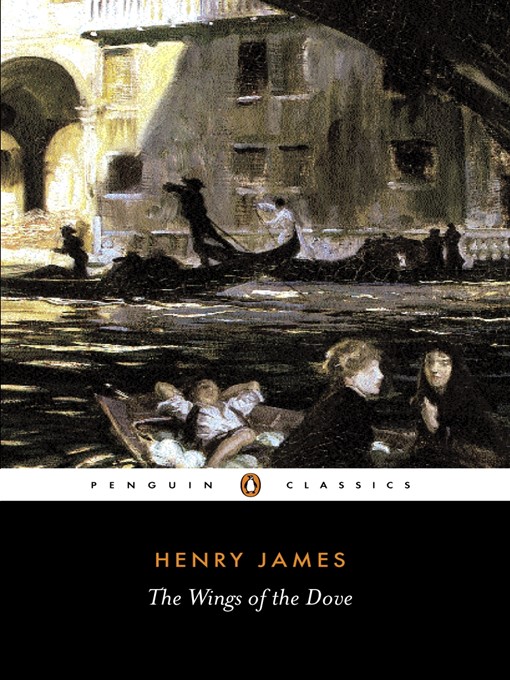
The Wings of the Dove by Henry James

A couple with misguided intentions befriends a wealthy dying woman, in hopes of receiving an inheritance in order to get married. When they do recieve the fortune, they must struggle with guilt, hidden feelings and the memory of their generous friend.

Full text Online

Wikipedia article

Henry James Biography